
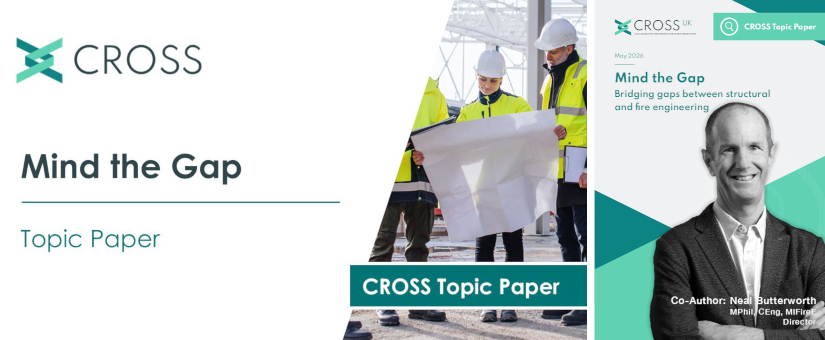
Where does structural engineering end… and fire engineering begin?
It’s a question many project teams will recognise, not usually at the start, but somewhere along the way. Often when things don’t quite line up as expected and someone around the table pauses and asks: “who’s actually covering this?”
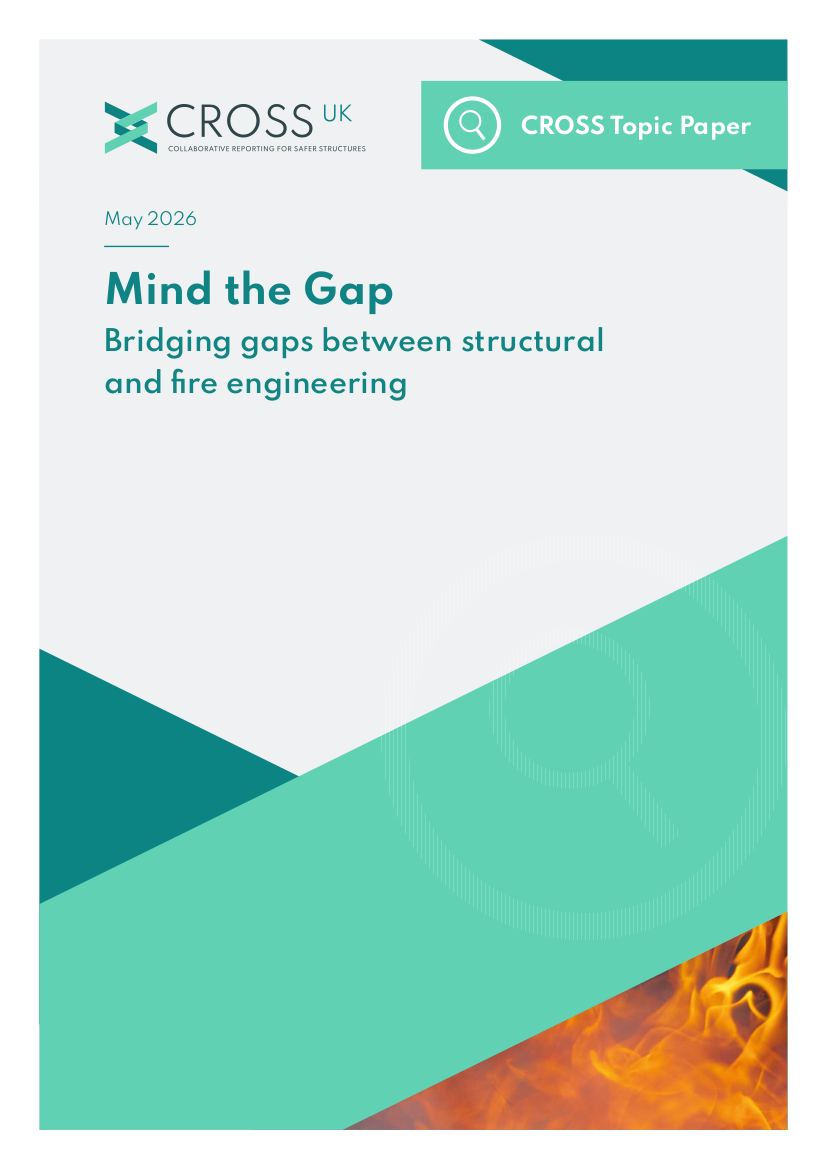
Recently, that question has been brought into sharper focus by the latest Topic Paper from Collaborative Reporting for Safer Structures (CROSS), “Mind the Gap – Bridging gaps between structural and fire engineering”. The paper brings together insight from CROSS’s Fire Safety Expert Panel, drawing on real experiences, observed challenges and shared concerns across the built environment.
Our Director, Neal Butterworth, is part of that expert panel, contributing alongside peers from across the industry. In developing those insights, Neal also worked closely with colleagues and collaborators, including our very own Structural Fire Engineering (SFE) team, led by Florian Block and Iolanda Del Prete, supported by a wider a wider team of experienced engineers, reflecting the kind of cross-discipline thinking the paper itself advocates.
The paper reflects a growing recognition across the industry that, while both disciplines are well established, their interface is not always clearly defined or consistently coordinated. The result is that important aspects of structural performance in fire may not always be fully considered.
Florian Block, Associate Director, Structural Fire Engineering
From Experience to Paper
What’s interesting about this paper is not just the conclusions but the thinking behind it. Much of it reflects conversations that have been happening across projects for years:
- Where does responsibility for structural performance in fire actually sit?
- At what point does a fire strategy meaningfully influence structural design?
- And how confident are we that a compliant structural design will behave as expected in a real fire scenario?
These aren’t theoretical questions. They tend to arise in live projects, often at points where disciplines overlap, assumptions are tested or decisions made earlier in the design need to be revisited.
The CROSS-UK paper doesn’t set out to prescribe a single answer. Instead, it highlights that the interface itself – structural and fire engineering – is where uncertainty can arise, particularly if it isn’t actively managed.
A Gap Many will Recognise
For most in the industry, the idea of a “gap” won’t feel unfamiliar. Projects are more complex than ever. Teams are larger. Responsibilities are split across more parties and while guidance exists within each discipline, how these come together is not always as clearly defined. In practice, that can look like:
- Fire strategies developing separately from structural thinking
- Structural designs that meet loading requirements but don’t fully consider fire scenarios
- Late-stage coordination issues, where assumptions made in isolation begin to conflict
- Designs that are compliant, but still raise questions about real performance
None of this is about shortcomings in individual disciplines, quite the opposite. It reflects how design processes have evolved and how important coordination has become.
Why this Matters Now
There’s a growing recognition across the industry that this interface matters more than it used to. Modern construction methods, new materials, sustainability drivers, and increasingly complex building forms are all changing how buildings behave. At the same time, expectations around safety, particularly post-Grenfell, have rightly increased. The result is a shift in focus:
→ from “does it comply?”
→ to “how does it actually perform?”
That shift is where structural fire engineering becomes more relevant, not as an add-on, but as a way of bringing disciplines together.
Closing the Gap in Practice
One of the key messages behind the CROSS-UK paper is that identifying the gap is only the starting point. What matters is how it is addressed in practice.
At DFC, this is something we see regularly across projects. Structural Fire Engineering sits directly at that interface, working with structural engineers, fire consultants, architects and contractors to help translate fire strategy into something that can be understood, tested and coordinated with the structure.
That might involve:
- Interpreting how fire scenarios influence structural response
- Supporting early design decisions where layout and fire strategy are still evolving
- Helping teams navigate uncertainty around guidance, Eurocodes or performance-based approaches
- Providing a clearer link between compliance and actual behaviour
It’s rarely about adding complexity, more often, it’s about bringing clarity where disciplines meet.
The Questions We Keep Hearing
If the conversations behind this paper feel familiar, it’s because many teams are already facing them:
- “We have a fire strategy but how does it affect the structure?”
- “Who is responsible for structural performance in fire?”
- “We’ve achieved compliance but are we confident in real performance?”
- “Are we considering fire early enough in the design process?”
- “Why are coordination issues appearing late in the programme?”
These are exactly the kinds of questions that prompted the discussion captured in the CROSS paper and they’re likely to keep shaping how projects are delivered going forward.
“Performance-based design gives us the ability to look beyond prescriptive requirements and understand how a structure is likely to respond in a real fire scenario. In practice, the challenge is not just carrying out that analysis but making sure the assumptions, results and limitations are clearly understood and consistently applied across the wider design team.”
Iolanda Del Prete, Senior Associate, Structural Fire Engineering
The publication of “Mind the Gap” is not a final answer but part of an ongoing industry conversation. One that recognises that improving building safety isn’t just about stronger guidance within disciplines but about how those disciplines come together.
For those involved in design and delivery, it’s well worth a read.
Further Reading
You can read the full CROSS-UK Topic Paper here:
Mind the Gap – Bridging gaps between structural and fire engineering
- Posted by Design Fire Consultants
- On 3rd June 2026


0 Comments