
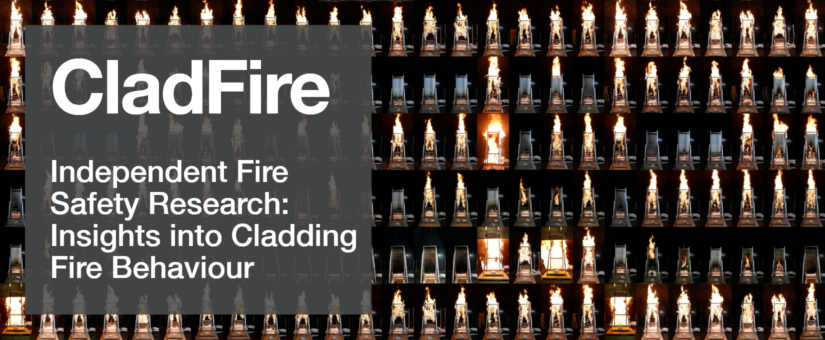
CladFire Research Launch
We are pleased to introduce CladFire, a research initiative developed by DFC in collaboration with The University of Edinburgh’s Fire Research Centre (EFRC). The project brings together new laboratory fire‑testing data to help fire safety professionals better understand how different cladding materials and configurations behave in fire, particularly where existing information is limited or unclear.
CladFire is designed to support evidence‑led decision‑making across the built environment. While the research does not determine compliance or building safety outcomes, it offers an additional source of transparent data for practitioners to consider alongside established guidance and assessment frameworks.
Why CladFire matters
Since the Grenfell Tower fire, the industry has faced ongoing challenges when assessing existing external wall systems. In many cases, relevant test data is incomplete, unavailable, or not directly applicable to the specific combinations of materials found on real buildings.
CladFire addresses this gap by providing:
- Consistent laboratory test data on cladding and insulation materials
- Clear, accessible presentation of observed fire behaviour
- Comparative data for different tested configurations
- Downloadable raw data for further analysis
Fire safety engineers are frequently required to make complex, risk‑based judgements using limited or non‑systematic data. CladFire has been developed in response to this challenge, with the aim of strengthening the available evidence base rather than offering definitive conclusions on safety or compliance.
Explore CladFire
The CladFire data is now available on our website. Users can:
- Select and explore tested material combinations
- Review comparative data across multiple configurations
- Access raw test data files for independent analysis
- Filter results to focus on materials and arrangements most relevant to their projects
All data is accompanied by clear notes on test conditions and analysis of the data to help users better understand the context of each test – relative to every other test.
How CladFire supports practitioners
CladFire is designed for:
- Fire engineers conducting risk assessments
- Building safety teams seeking clearer evidence
- Regulators and reviewers needing transparent data sources
- Clients and responsible persons trying to understand material behaviour
The dataset may help inform professional judgement where material‑specific fire behaviour is relevant, including in contexts such as PAS 9980 assessments, provided it is used alongside established methods, building‑specific information, and competent engineering judgement.
In CladFire research, we have tested and collected critical data on the fire behaviour of various cladding and insulation products. Our goal is to inform engineers and stakeholders about the spectrum of fire hazard posed by different materials. Through real fire testing on various cladding materials and configurations, CladFire collected vital data that will be accessible to industry professionals.
CladFire will allow users to choose their specific combinations of selected materials that have been tested, enabling them to view comparative data and analyse fire performance metrics more easily. Additionally, raw data files will be available for download, facilitating further analysis tailored to individual needs.
Collaborators’ insights
“We’re excited to share the findings of this research,” said Neal Butterworth, Director of Design Fire Consultants (DFC). “CladFire represents a pivotal step forward in our understanding of cladding performance in fire scenarios, ultimately contributing to safer building practices.“
Dr. Angus Law, Senior Lecturer in Fire Safety Engineering at the University of Edinburgh and Project Lead for CladFire, added: “The Grenfell Tower Inquiry recognised the need for a library of fire test information. We hope that by making the data from the CladFire project publicly available, we can help practitioners to better understand the potential hazard from combinations of products and materials. Our partnership with Design Fire Consultants (DFC) is fundamental to ensuring that these findings make a real impact on fire safety standards.”
CladFire research findings are available via a newly launched online platform hosted on DFC’s website. Whether you are a fire safety engineer, a building inspector, or involved in regulatory compliance, CladFire allows users to explore tested material combinations and review comparative data, supporting informed consideration of reported fire performance metrics.
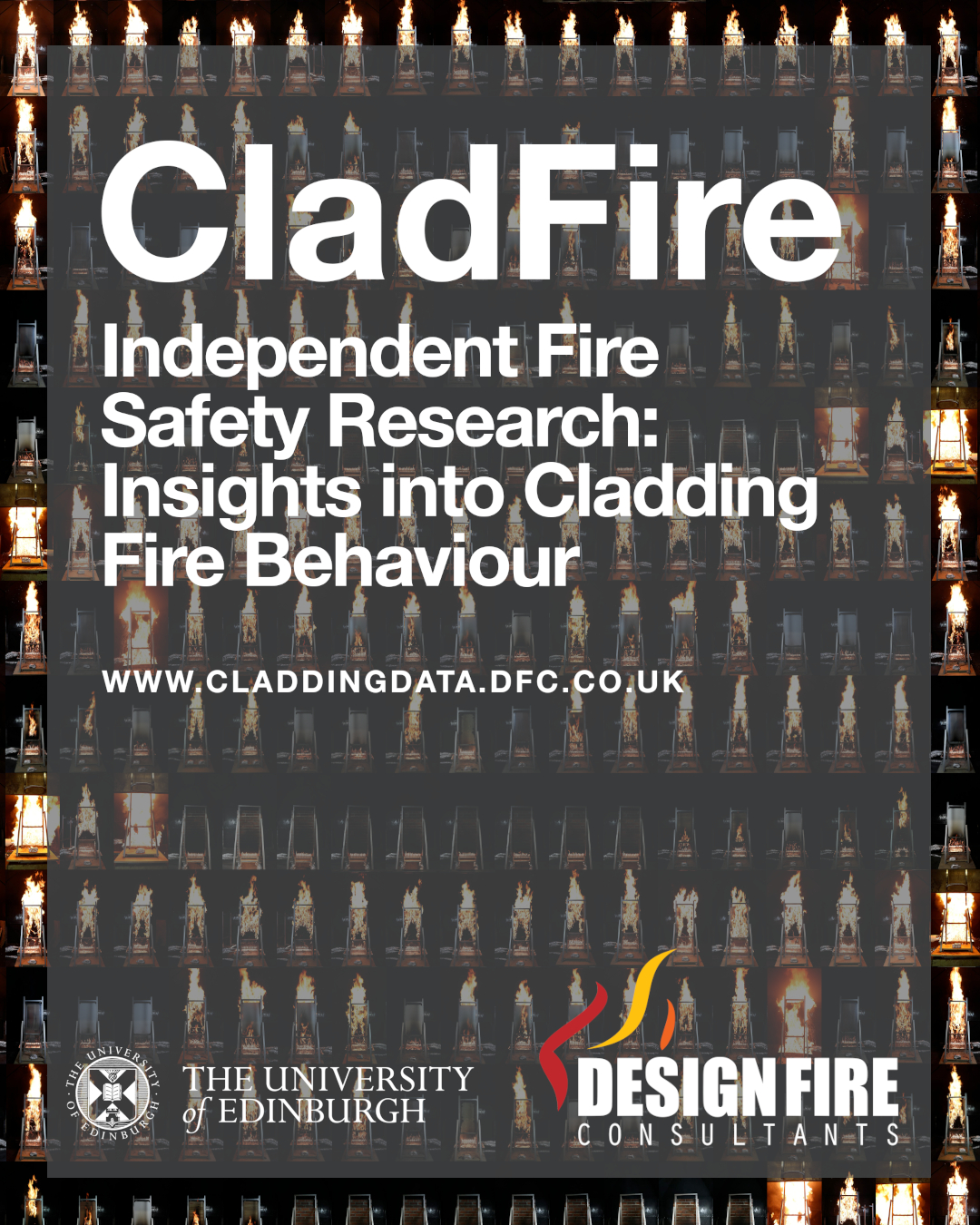
For further details on the CladFire research, please visit: www.claddingdata.dfc.co.uk
Our research collaboration
DFC would like to thank all those who contributed to the delivery of the CladFire research project, in particular:
- Dr Angus Law, Senior Lecturer in Fire Safety Engineering, School of Engineering, The University of Edinburgh, for leading the research programme and providing expert technical insight throughout.
- Dr Cameron MacLeod, Postdoctoral Research Associate in Fire Safety Engineering, School of Engineering, The University of Edinburgh for undertaking the experimental research work and for processing and analyses of the research data.
- The wider research team at the University of Edinburgh, whose technical expertise and rigour in fire behaviour testing were essential to the delivery of the project.
- Dr Adeyanju Oluwa, Senior Fire Engineer at DFC, for the development of the interactive digital platform and shaping the practical accessibility of results.
- Co-funding from the EPSRC Impact Acceleration Account, University of Edinburgh 2022 (ref: EP/X525698/1).
- Industry stakeholders, whose engagement to improving fire safety understanding helped shape and guide the research.
- Impulse Branding & Web Ltd, for the design and development of the online system used to collect, display and compare the CladFire research results.
We would like to thank everyone involved for their expertise, collaboration and commitment to improving fire safety understanding.
DISCLAIMER
Whilst the University of Edinburgh and Design Fire Consultants have used reasonable endeavours to ensure the accuracy of the information provided, no warranty is granted as to the accuracy of the information or for the use of the information. The University of Edinburgh and Design Fire Consultants accept no liability whatsoever in respect of any claim or claims arising from use by any third party of any such information. All conditions and warranties, express or implied, whether arising under statute or common law including, but not limited to, conditions and warranties as to quality, merchantability and fitness for purpose are hereby excluded.
- Posted by Design Fire Consultants
- On 18th February 2026


0 Comments