
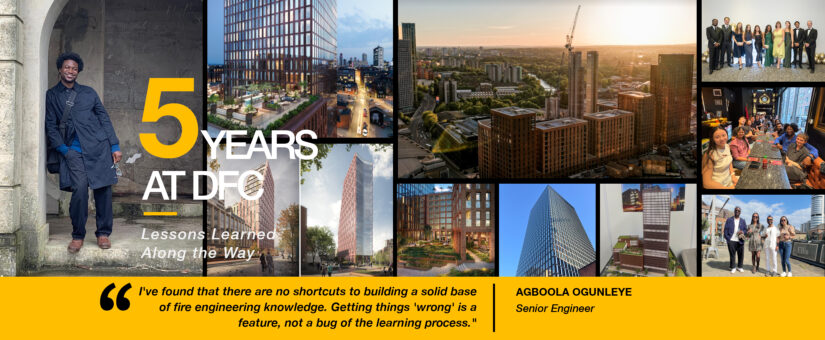
From Manchester to Edinburgh: My First Five Years at DFC
By Agboola Ogunleye, Senior Engineer
August 2026 marked my fifth year at DFC. Whilst life can be hectic, I wanted to take a moment to pause and reflect on my journey so far and what the future holds.
I’m hoping to share some of the challenges I have faced and the ways I have learned and, importantly, recognise the support I have received from my colleagues at DFC in my progress from a Graduate Engineer in Manchester in 2021 to a Senior Engineer moving to Edinburgh in 2026 and helping to establish a new DFC presence in Edinburgh.
The Early Days as a Graduate: September 2021 to April 2023
As a Graduate Engineer based in Manchester, I became involved in two large-scale residential projects, One Port Street and Waterhouse Gardens. Both projects provided foundational experience that I still draw upon.
On these projects, I started as a Project Engineer, supporting the Project Lead with preparing fire strategy reports and calculations, including stair capacity and external fire spread, as well as attending project meetings.
These experiences provided initial insights into what it meant to be a Fire Engineer, which I shared in my previous blog post on my first year at DFC. In retrospect, I can now see these insights were just the tip of the iceberg when it comes to a Fire Engineer’s role in construction.

Images: Waterhouse Gardens, Manchester, ©DomisConstruction
DFC colleagues have always provided me with a stable platform and continuous encouragement to increase my involvement in projects; this meant being entrusted with presenting at external project meetings and workshops alongside the Project Lead. This additional responsibility quickly led to me receiving queries from design team members (such as report deadlines and technical design input); being asked questions meant I was starting to be seen as someone with answers…which was scary!
On Port Street, during a façade design workshop, I still remember being completely baffled when I was directly asked to provide DFC’s comments on project-specific external wall construction for the first time. This experience (and others like it) led to me getting stuck in with deeper research and quizzing my colleagues (Stephen, Stuart and Iris, to name a few) to better understand the important fire safety considerations.

Images: One Port Street, Manchester, ©SelectProperty
Being honest, the learning curve in those early days was daunting; I still remember being frustrated when I didn’t get the ‘correct’ answer, which meant realising just how little I really knew and understood. It took longer than I would’ve liked to realise I was being quite impatient with myself. My DFC colleagues helped me see this by constantly giving me chances to try new things and sometimes to ‘get it wrong’, while explaining things in detail.
In time, I’ve found that there are no ‘shortcuts’ to building a solid base of fire engineering knowledge, getting things ‘wrong’ is a feature, not a bug, of the learning process.
Whilst I would never claim to know everything I was talking about, by the end of my first two years I certainly felt more capable of being the expert in the room, which meant helping our clients design and build some fantastic buildings.
Learning through Teaching: April 2023 to April 2025
The next two years were defined by increased responsibilities in technical project delivery and guiding new junior colleagues in their learning. This meant stepping up to become the Project Lead for numerous DFC projects, including the two aforementioned projects, alongside One Cathedral Square – one of the first few DFC projects that went through the ‘Gateway 2’ process with the 2024 edition of BS 9991 as its design basis.
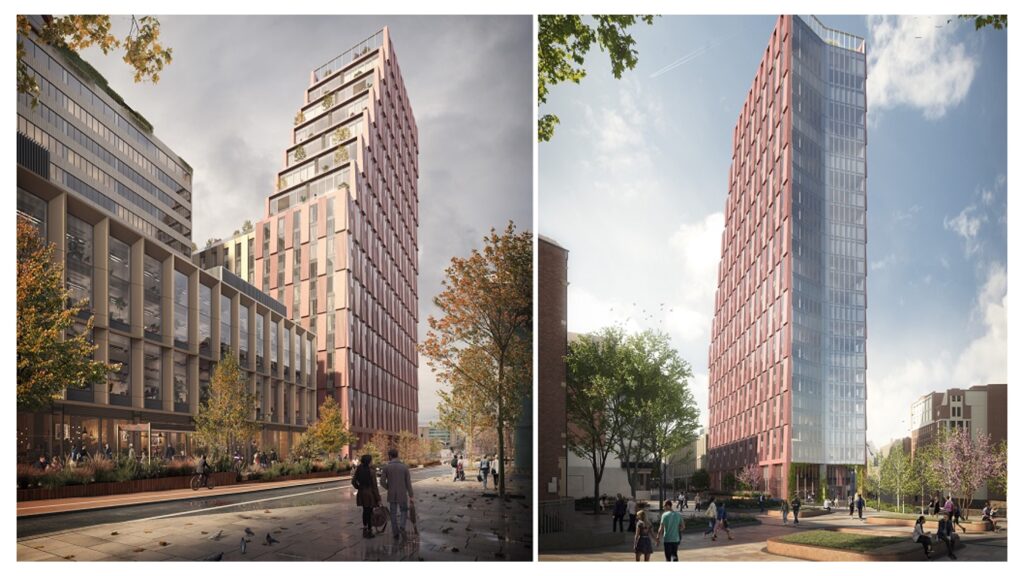
Image: One Cathedral Square, Manchester, ©JonMatthewsArchitects
Being a Project Lead meant being responsible for all aspects of technical DFC project delivery, coordinating fire strategy development, and liaising with relevant stakeholders and authorities to gain the required approvals (e.g., the Building Safety Regulator for Higher Risk Buildings).
During fire strategy development for One Cathedral Square, a few new challenges came up. Firstly, the new Gateway 2 process was now underway following the end of the transitional period in April 2024, which meant there were few approved projects available as guiding examples. Secondly, BS 9991:2024 came into effect in November 2024, introducing new recommendations from the 2015 edition—another relative unknown.
Both represented fundamental changes in fire design recommendations and building regulation approval processes for high-rise residential buildings in England. With limited precedents, I realised this meant navigating uncharted waters in a new role, which came with additional responsibilities.
Given these factors, I immediately knew tackling the project solo would be a non-starter and that I needed to implement the usual clichéd quotes about “there’s no I in team” and “teamwork makes the dream work”. Clichés aside, I figured that solid project delivery hinged on me relying on some of our experienced in-house experts.
The project CFD dream team of Iain, Weimiao and Ekaterina helped me define CFD demonstrations in line with BS 9991’s recommendations on lift lobby smoke ventilation. I owe this group immensely for the countless number of CFD iterations they produced to support the fire strategy and peer review process. All their hard work paid off as we received minimal comments from the BSR’s CFD reviewers, which I reckon was a massive success!
The latter parts of this period saw me guiding new junior colleagues through some of their own challenges. A real learning experience came when I was trying to explain the difference between fire separation, compartmentation and fire resistance. I began with a degree of self-assurance in my knowledge but as the words came pouring out, the explanation became tied up in knots of contradictions. I realised and admitted sheepishly that I had an incomplete understanding. I decided it was wise to go back to basics: Approved Document B. This moment (and others like it) showed me that the teaching and learning process is not a one-way street and clearly highlighted where I could build my own understanding.
Endings and New Beginnings: April 2025 to Present
Both One Port Street and Waterhouse Gardens are now completed and occupied. This marks an end of sorts to the foundational projects that I’d been involved with from the early design stages through to construction and handover, a cycle of growth and development which I think symbolically aligns with my own.
The last year saw my role in DFC shift as I became a Team Leader for the Manchester office alongside my colleague Stephen. The role formalised the responsibilities I have been entrusted with in recent years, supporting me in continuing to provide pastoral care, guidance and support to my colleagues.
My time in Manchester drew to a close in August 2026 when I relocated to Edinburgh, where I spent five years studying as an undergraduate at the University of Edinburgh before joining DFC.
I’m gutted that I’ll no longer be a constant fixture in the Manchester office but the team remains in great hands and will continue to grow and develop. I’ll be sure to pop in frequently to make sure they haven’t all forgotten me!
Moving back to Edinburgh was a culmination of long-standing personal drivers and DFC’s established plan to open an Edinburgh office. The move will strengthen DFC’s presence in Scotland, bringing numerous business benefits, including strengthening existing relationships between DFC and the brilliant fire safety researchers at the University of Edinburgh.
All of which is to say, here’s to a new beginning and to helping establish DFC’s presence in Edinburgh.
Like all the challenges I’ve faced so far in my career, this is another one I’ll be embarking on with the DFC team behind me every step of the way.
Watch this space…




- Posted by Design Fire Consultants
- On 29th September 2026
0 Comments