
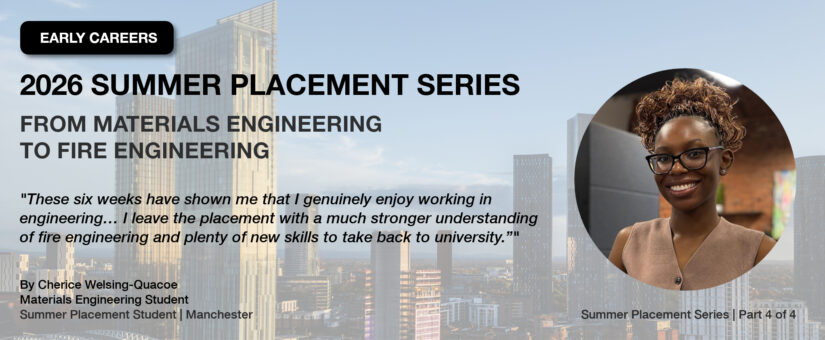
From Materials Engineering to Fire Engineering: Part 4 of 4
Our 2026 Summer Placement Students: Cherice Welsing-Quacoe (Part 4 of 4)
Throughout the summer, we’ve welcomed students from a range of academic backgrounds to spend time with our teams and gain an insight into life at DFC.
As part of this series, we’ve been sharing reflections from our 2026 summer placement students, highlighting the experiences, opportunities and lessons that have shaped their time with us.
We’re concluding the series with Cherice Welsing-Quacoe, who spent the summer with our Manchester team. A Materials Engineering student, Cherice reflects on gaining exposure to a broad range of fire engineering activities, visiting sites and seeing first-hand how engineering decisions translate from drawings into the built environment.By Cherice Welsing-Quacoe, Summer Placement Student
By Cherice Welsing-Quacoe, Summer Placement Student
‘These six weeks have shown me that I genuinely enjoy working in engineering… I leave the placement with a much stronger understanding of fire engineering and plenty of new skills to take back to university.
As a Materials Engineering student, I came into this placement eager to learn about the day-to-day life of a fire engineer, and I left with a much broader understanding of what an engineer’s role can involve. I learnt that a drawing will tell you how a building is intended to perform; a technical assessment can assess how that design responds to real-world conditions; and a site visit will show you how it actually performs in reality.
Looking back, I can honestly say that my six-week summer placement at DFC gave me a fantastic insight into both fire engineering and professional life. I gained exposure to a range of fire engineering activities, including structural fire engineering, external fire spread, design notes, fee proposals and site visits. The placement helped me see how my engineering background could be applied in practice, while continuing to develop my technical skills and giving me a better appreciation of the practical and commercial aspects of the profession.
From my first week, I was exposed to a wide variety of projects, giving me an insight into how the technical software and concepts I had been learning could be applied in practice. I became familiar with the software used by the team and began to understand how it supported different stages of the fire engineering process. I was also exposed to a range of project types, from historic and heritage buildings to refurbished hospitals and theatres, as well as new developments. Seeing such a broad range of projects gave me a better appreciation of the different considerations and challenges that can arise in fire engineering.
Perhaps the most rewarding part of the placement was growing in confidence and becoming more independent in my approach to tasks. I had the opportunity to contribute to activities such as design notes, architectural mark-ups, PAS documents and research into Approved Document B and British Standards. Initially, there was a lot of new terminology and information to take in, but I became increasingly confident in finding answers to questions independently, knowing when to ask for help and applying the feedback I received. The regular feedback meetings were particularly valuable, as they gave me the opportunity to discuss what I had learned and receive tailored guidance.
The highlight of my placement was definitely getting out of the office and seeing fire engineering in practice. I attended two site visits, including a high-rise residential development at RIBA Stage 5 and an existing RIBA Stage 2 building set to be converted into office and commercial space. Seeing different stages of construction, fire stopping, cavity barriers and cladding systems made a huge difference to my understanding of the drawings and mark-ups I had been working on. Wearing full PPE and seeing fire stopping being installed by abseilers was a particularly memorable experience!
Another highlight was being able to visit the London and Leeds offices. It was great to meet more of the DFC team and experience the different offices, as well as explore two cities I had not spent much time in before. Alongside the technical experience, the lunches, conversations and time spent with the team made it very easy to feel part of DFC.
Looking back, I have developed much more than just my technical skills. I have improved my communication, organisation, research and time management, while becoming more confident in asking questions and sharing my ideas.
Most importantly, these six weeks have shown me that I genuinely enjoy working in engineering. I am very grateful to everyone at DFC for making me feel welcome, giving me such a broad range of experiences and being so willing to answer my questions. I leave the placement with a much stronger understanding of fire engineering, plenty of new skills to take back to university and a very positive view of what a career in the profession could look like.
Rear Part 1, 2, 3 and 4 here.
- Posted by Design Fire Consultants
- On 24th September 2026
0 Comments