
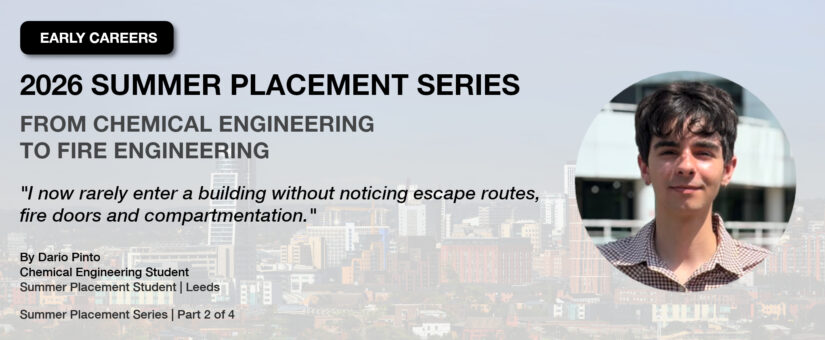
From Chemical Engineering to Fire Engineering: Part 2
Our 2026 Summer Placement Students: Dario Pinto (Part 2 of 4)
Throughout the summer, we’ve welcomed students from a range of academic backgrounds to spend time with our teams and gain an insight into life at DFC.
As part of this series, we’re sharing reflections from our 2026 summer placement students, highlighting the projects they’ve been exposed to, the skills they’ve developed and the experiences that have shaped their time with us.
Next up is Dario Pinto, who joined our Leeds office this summer. A Chemical Engineering student at the University of Edinburgh, Dario reflects on how a university lecture sparked an interest in fire engineering and how his placement helped him explore new areas of the profession.
From Chemical Engineering to Fire Engineering: My Summer at DFC
‘I now rarely enter a building without noticing escape routes, fire doors and compartmentation.’
I study Chemical Engineering at the University of Edinburgh and my interest in fire engineering began during a lecture as part of my Process Safety and Environmental Issues course. The lecturer was an academic from Edinburgh’s Fire Research Centre, and after speaking to him about his research, I became curious about the profession and the role fire engineers play in keeping people safe.
Coincidentally, the university careers fair took place that same week. While researching the companies attending, I came across DFC and was particularly interested in its computational modelling work. I had enjoyed studying heat, mass and momentum transfer, so seeing these principles applied to fire behaviour made fire engineering feel like an interesting extension of my degree.
During my placement, I was exposed to a wide range of projects and activities, including fire strategy reports, drawing mark-ups, radiation assessments, CFD modelling and research into how regulations have evolved over time. Moving from Chemical Engineering into areas such as structural fire engineering was challenging at first, as many of the systems, regulations and technical terms were completely new to me. However, I was encouraged to take on unfamiliar work and always felt comfortable asking questions when I needed help.
One of the highlights of my placement was contributing to a computational modelling project that explored how a design proposal would perform in a fire scenario. I quickly realised that producing a useful model involved much more than creating the geometry and running the software. It required careful consideration of mesh sizing, how the mesh interacted with the structures and how these decisions affected the quality and interpretation of the results. My buddy, Andy, was particularly helpful in explaining how to develop an appropriate mesh and assess whether the outputs were meaningful.
The project was especially rewarding because I saw how the modelling could influence the design. Before the placement, I had very little understanding of CFD. I have now chosen Computational Fluid Dynamics as a module for next semester and contacted an academic about potentially completing a master’s project involving a CFD solver adapted for supercomputing architectures.
One thing that surprised me was the importance of regulations within fire engineering. Before the placement, I expected the work to focus mainly on calculations and simulations. In reality, much of it involved interpreting guidance, assessing risk and justifying decisions. It showed me that engineering is not always about finding a single right answer. Often, it is about using technical knowledge and professional judgement to reach the most appropriate outcome. I now rarely enter a building without noticing escape routes, fire doors and compartmentation.
I also enjoyed DFC’s culture of continuous learning. The variety of projects, Lunch and Learn sessions and conversations with colleagues encouraged me to think more broadly about my future studies and career options.
My advice to future placement students would be to speak up about the things that interest you. I mentioned my interest in computational modelling on my first day and was given the opportunity to get involved with it shortly afterwards. I would also encourage students not to shy away from unfamiliar work, as the projects that seem the most challenging at first can become the most rewarding.
Over the coming weeks, you’ll hear from some of my fellow summer placement students as they share their own experiences of life at DFC, sharing their own reflections on what they’ve been involved in and what they’ve learned along the way.
Read Part 1 here.
- Posted by Design Fire Consultants
- On 3rd September 2026
0 Comments